

Landmark Supreme Court Ruling: Freight Brokers Can Be Held Liable for Negligent Hiring
In a landmark ruling for road safety, a unanimous U.S. Supreme Court has ruled that freight brokers are not shielded from state laws when they negligently hire transportation companies to haul their freight.
The opinion resolves a hotly contested legal issue over whether a federal law known as the Federal Aviation Administration Authorization Act (FAAAA) preempts state-law negligence and personal injury claims against freight brokers involved in truck crashes.
The justices agreed that such negligence claims fall within a safety exception in the law and that freight brokers can be held liable in the same way that trucking companies are treated under state laws.
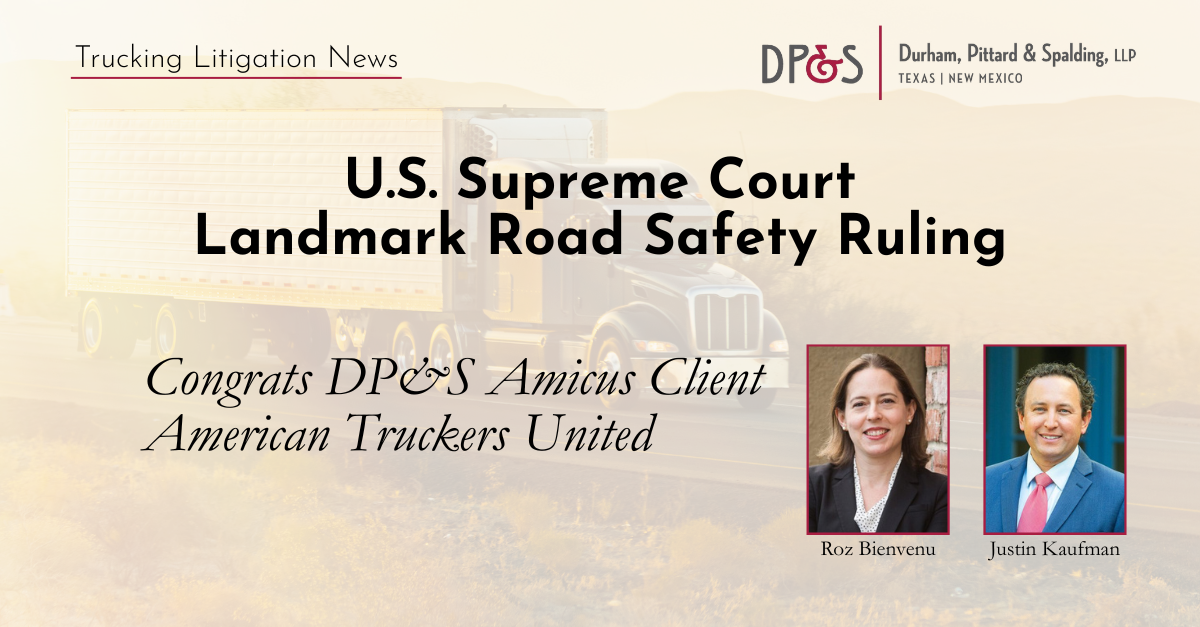
Durham, Pittard & Spalding has extensive experience handling matters involving FAAAA preemption and appellate trucking litigation. Firm partners Roz Bienvenu and Justin Kaufman drafted an amicus brief for the U.S. Supreme Court case on behalf of American Truckers United, a group of motor carriers and truck drivers advocating for safety and accountability within the transportation industry.
In his concurring opinion, Justice Brett Kavanaugh emphasized that Congress never intended for freight brokers to receive broader protection from liability than trucking companies themselves.
“It’s hard to read the statute as written and conclude that Congress subtly sliced and diced state tort law so that trucking companies would be subject to state tort suits for accidents, but brokers would operate free of any such tort liability,” Kavanaugh wrote, adding that preempting state tort law without imposing federal safety requirements on broker selection would allow brokers to operate in a “black hole with no meaningful safety-related regulation.”
The amicus brief drafted by Bienvenu and Kaufman underscored how freight brokers are incentivized to hire low-cost motor carriers that are willing to cut costs by foregoing safety measures and evading regulatory compliance.
“If brokers are immunized from tort liability, they will have an unrestrained incentive to hire the cheapest motor carriers available for every load, regardless of poor safety records, regulatory non-compliance, defective equipment, and other red flags,” Bienvenu and Kaufman wrote in the amicus brief.
The case, Montgomery v. Caribe Transport II, LLC, arose from a 2017 crash in Illinois in which Shawn Montgomery lost part of his leg after a semi-truck struck his parked tractor-trailer. Montgomery alleged that freight broker C.H. Robinson negligently hired Caribe Transport despite known safety concerns involving the carrier.